Building Resilience: Embracing Green, Yellow, and Red Days for Sustainable Progress
- Jillian Guralski
- Jun 7
- 5 min read

The Myth That One Difficult Day Ruins Everything
Here is a belief that quietly sabotages a lot of people: one hard day means you have lost your progress. You miss a workout, skip a habit, shut down emotionally, and suddenly the story becomes, "I have failed." That story is wrong, and it is worth unpacking why.
Progress is not a straight line. It is a rhythm. And like any rhythm, it has louder beats and quieter ones. The goal was never to perform perfectly every single day. The goal was to build a system that works with your reality, including the reality that some days are genuinely hard.
That is exactly what the green, yellow, and red day framework gives you: a way to work with your days instead of against them.
What Green, Yellow, and Red Days Actually Mean
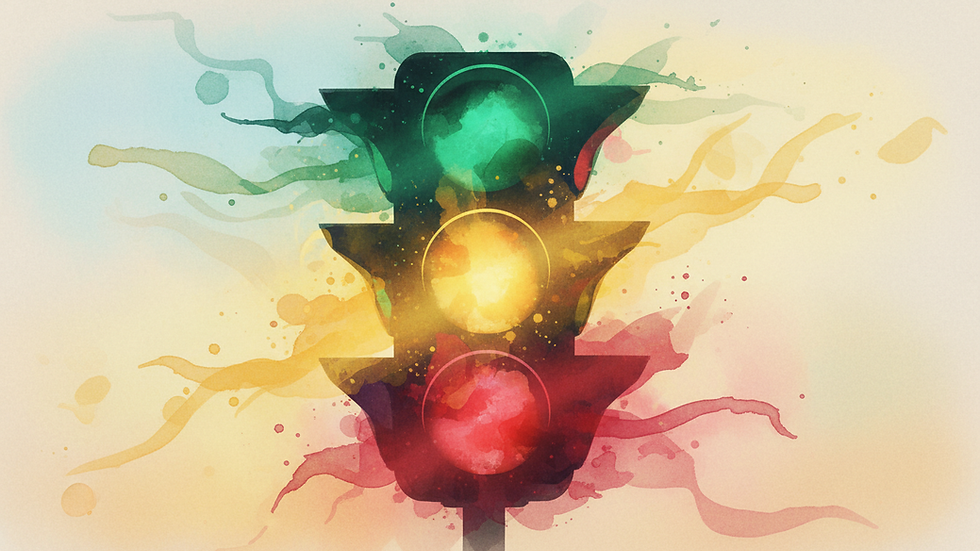
The traffic light system comes from a well-established framework in psychology called the Zones of Regulation. It maps your emotional and physiological state to three distinct zones, and each zone calls for a different response.
Green days are your optimal state. You feel calm, focused, and capable. Your nervous system is regulated, your logical brain is leading, and you can take on complexity. These are your days to push, build, and grow.
Yellow days are your caution zone. You are feeling frustrated, anxious, overwhelmed, or scattered. Your emotional brain is starting to take over. This is not a sign that something is wrong with you. It is a signal to pause, check in, and slow down before things escalate.
Red days are your stop zone. You are running on survival mode. Stress, panic, exhaustion, or emotional flooding have taken the wheel. Rational thinking becomes genuinely harder on these days. The brain's fight-or-flight response reduces cognitive capacity. Expecting peak performance here is not discipline. It is a setup for shame.
Naming which day you are having changes everything. It shifts your goal from "perform well" to "respond appropriately."
Green Days: Build While the Conditions Are Right
When you are in a green day, use it intentionally. These are the sessions where you go deeper, take on more, and build the habits that will carry you through yellow and red days.
Think of green days as making deposits into a resilience account. The more you build during good conditions, the more you have to draw from when conditions get difficult. This is why consistent effort during green days matters more than heroic effort on red ones.
Practically, green day habits might look like:
Completing your full routine without modification
Tackling harder tasks or decisions you have been deferring
Planning and preparing for the yellow and red days ahead
Building the systems (meal prep, schedules, support check-ins) that reduce friction when energy is low
Yellow Days: Slow Down, Not Stop
Yellow days get misread most often. People either push straight through them, pretending they feel fine, or they collapse into them entirely, abandoning the day as a loss. Both responses miss the point.
A yellow day is asking you to adjust, not quit. Research on emotional regulation suggests that simply naming what you are feeling, "I am anxious," "I am overwhelmed," "I am scattered," reduces the intensity of that emotion in the brain. Labeling activates the prefrontal cortex and dials down the amygdala's alarm response.
On yellow days, the goal is a modified version of your intention, not a cancelled one:
Shorten the workout instead of skipping it entirely
Write one paragraph instead of a full chapter
Do the single most important task and let the rest wait
Use calming tools: deep breathing, a short walk, or a five-minute reset
Psychologist Dr. Randy Larsen's research on emotional well-being suggests that progress and happiness are determined by the ratio of good days to hard ones over time, not by the elimination of hard days altogether. A sustainable life is not a life without yellow days. It is one where yellow days are met with self-awareness instead of self-criticism.
Red Days: The System Was Built for This
This is the part most progress frameworks skip entirely: what to do when you genuinely cannot.
Red days are real. Grief is real. Burnout is real. Illness is real. There will be days when showing up at full capacity is simply not possible, and no amount of motivation or discipline changes that. A resilient system does not pretend otherwise.
On a red day, the goal is safety and recovery, not performance. That might mean:
Resting without guilt
Reaching out to someone in your support network
Doing one small, gentle thing that keeps the thread alive (a five-minute walk, a single glass of water, one deep breath)
Letting the day be what it is, without catastrophizing it into a permanent identity
The 90-second rule from neuroscientist Dr. Jill Bolte Taylor offers a useful lens here: the physiological surge of an emotion lasts roughly 90 seconds in the body. What extends it beyond that is the story we tell about it. On red days, the most powerful thing you can do is allow the emotion to move through without amplifying it with a narrative about failure.
Building a System That Accounts for All Three
The real shift this framework asks for is one of design. Instead of building a routine for your best self on your best days, you design one with all three zones in mind.
Green Day Plan
Full routine. Push further. Prepare for harder days ahead. Build systems and make deposits into your resilience reserve.
Yellow Day Plan
Modified routine. Name what you feel. Do the minimum meaningful version of your goal. Use calming tools to regulate before deciding.
Red Day Plan
Rest and recover. Reach out. Do one tiny, gentle thing. Protect yourself from the story that this day defines your trajectory.
Progress Is Cumulative, Not Linear
A 2026 study published in PLOS One outlined a four-stage resilience model: anticipating challenges, minimizing impact, managing in the moment, and mending afterward. Notice that none of those stages is "avoid difficulty." Every stage assumes difficulty is coming. The system exists to meet it.
That is the real work of resilience. Not becoming someone who never has red days. Becoming someone who has built a life sturdy enough to hold them.
Green days build momentum. Yellow days build self-awareness. Red days build compassion. All three are part of the same journey.
So the next time a hard day arrives, ask yourself: what kind of day is this? Then let your system answer.
Note: This post is for informational and motivational purposes only. It is not a substitute for professional mental health support. If you are experiencing prolonged emotional distress, please reach out to a qualified mental health professional.
Comments